This preservative is hiding in food AND makeup.
Reducing your toxic load is not about eliminating everything overnight. It is about understanding what is in the products you use daily and deciding what feels reasonable to replace.
Two ingredients that often go unnoticed:
Butylated Hydroxytoluene (BHT)
Butylated Hydroxyanisole (BHA)
They are not as commonly discussed as parabens or fragrance, but they deserve attention.
What Are BHT and BHA?
BHT and BHA are synthetic antioxidant preservatives. They are added to products to prevent oils and fats from going rancid. This extends shelf life and keeps cosmetics and personal care products stable.
They are commonly found in:
Moisturizers
Lipsticks
Makeup products
Some lotions and creams
Occasionally in packaged foods
Their job is preservation, without them, products would spoil faster.
Why Do Some People Avoid BHT and BHA?
Concerns around BHT and BHA stem from research conducted primarily in animal studies.
Studies have suggested potential links to:
Endocrine disruption
Cancer (including lung and liver tumors in animals)
Neurotoxicity
Organ stress at high doses
It is important to note that much of the data comes from laboratory studies using amounts higher than typical cosmetic exposure.
However, when evaluating ingredients, many people look not only at acute exposure but cumulative, long-term daily use.
Your skin is your largest organ. It is designed to protect you, but it also absorbs some of what you apply (I say this a lot). When preservatives are used in products that are applied daily, especially to the lips or large areas of the skin, some individuals choose a precautionary approach.
For many women, the decision is not based on panic. It is based on reducing repeated exposure where safer alternatives exist.
Why Cumulative Exposure Matters?
BHT and BHA may not appear alarming when viewed in isolation.
The question becomes more meaningful when you consider:
How many products you use each day
How many years you have used them
How multiple preservative systems may interact
Lowering your toxic load is about reducing the overall burden, not targeting one ingredient as “the villain.”
When you remove just a few high-frequency exposures, you shift the total picture.
Where do BHT and BHA Hide?
Long-wear lipsticks
Moisturizers with extended shelf life
Cream-based cosmetics
Some preservative systems in personal care products
Ultra-processed foods and snacks
👆👆 They are used as stabilizers. 👆👆
Not always the main active ingredient so they are usually listed further down the ingredient list.
What to do instead?
You do not need to panic over every ingredient label.
Instead:
Replace products as they run out.
Look for brands that state “BHT-free” or “BHA-free.”
Choose products with shorter ingredient lists.
Visit our Non-Toxic Living Page for tested toxic free options
Many clean beauty brands now use alternative antioxidants like vitamin E (tocopherol) to stabilize formulas.
The goal is not perfection. The goal is reduction.
The Bigger Picture
Modern life exposes us to more synthetic chemicals than at any other time in history. While regulatory agencies vary greatly with each country, it's important to be your own advocate for you and your family.
Reducing your toxic load is not about fear. It is about awareness and steady improvement.
If you apply a moisturizer or lipstick every day for twenty years, even a small concern may be worth reconsidering, especially when alternatives exist.
One swap.
One upgrade.
One less daily exposure.
That is how sustainable change works.
In health & frequency,
— Kate

Hi, I'm Kate
As founder of Doable with Kate, I believe life and business should feel simple and aligned. My background in architecture shaped my love for structure and design, but my personal health journey led me into holistic wellness and non-toxic living.
Now I help women clean up their homes and businesses, build them systems that feel both authentic and profitable.


“Do the best you can until you know better.
Then when you know better, do better.” - Maya Angelou
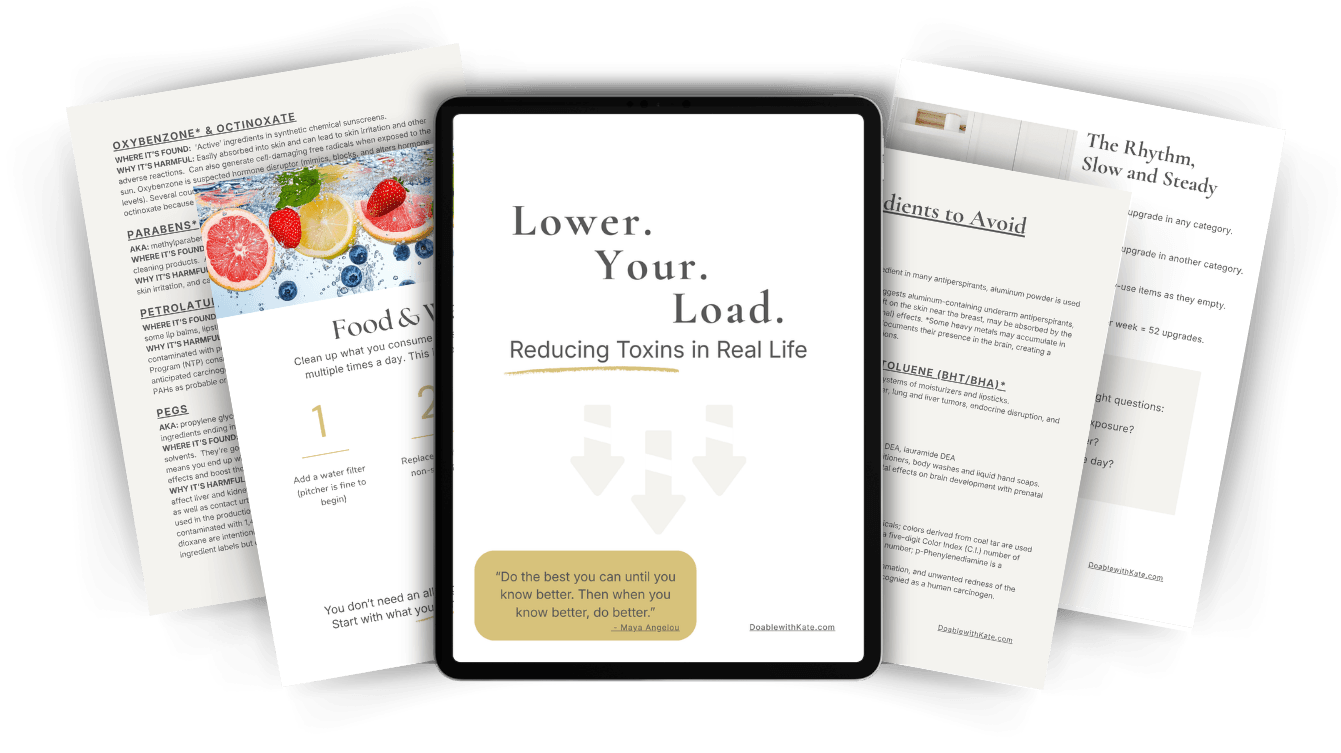
I've put together this guide 'Lower Your Load' explaining
the top 3 culprits of toxic exposure along with a
list of ingredients to avoid, so you can do better for yourself and your family.
We HATE spam. Your email address is 100% secure



© 2026 Kate Andrews | K8 Enterprises LLC - All Right Reserved | Terms & Conditions
This page may contains affiliate links, which means I may make a small commission at no extra cost to you.